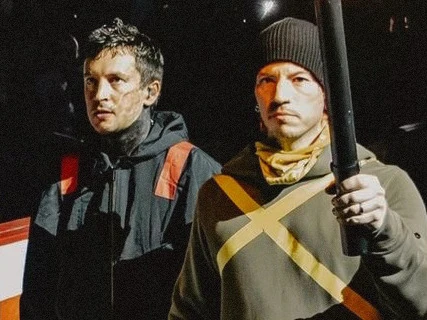
The Torchbearer
A flame that refuses to die, passed from one trembling hand to the next.

The Torchbearer is a blazing artifact in the world of Twenty One Pilots, a literal flame passed from hand to hand that embodies the grit of carrying hope through despair. It appears as a fiery torch, seared into the band's mythology as a symbol of defiance against the shadows within and without. In the lore, it is never a weapon—it is a beacon, clutched by those who choose to light the way for others through the mud and mist of the metaphorical trenches.
- Role
- Symbol of hope and guidance
- Affiliation
- The Banditos, the Clique
- First appears
- During the Trench era, notably in the 'Jumpsuit' music video and live performances
- Status
- Active, passed between characters in the narrative
Lore & Background
The Torchbearer originates from the world of Trench, where the Banditos resist the oppressive city of Dema. It is a physical torch that burns with a flame symbolizing defiance against the bishops' control over fear and despair. In the band's narrative, the torch is carried by key figures like the protagonist (often identified with Tyler Joseph's character) and other Banditos, signifying their role as leaders who refuse to let the light of hope be extinguished. The torch's flame is never extinguished, even in the harshest conditions, mirroring the unyielding spirit of the Clique.
In Their Own Story
The rain fell in sheets over the canyon, but the Torchbearer's flame refused to die. A Bandito, cloak soaked and trembling, held it high as they climbed the crumbling path. Behind them, a trail of others followed, their eyes fixed on the light. The torch had been passed from one runner to the next, each hand blistering but never letting go. Ahead, the glow of Dema's walls flickered, but the torch burned brighter, a silent promise that no bishop could snuff out what was carried in the heart. The wind howled, the mud tried to swallow their boots, but the flame licked the rain and roared on—a stubborn, living thing that remembered every hand that had held it.
Reader's Guide
The Torchbearer functions as a rallying point and a tool for navigation in the dark, both literal and metaphorical. In-world, it is wielded by the Banditos during their escapes from Dema, serving as a signal to others and a source of warmth against the cold of the city's influence. The torch is not magical in a fantastical sense but carries immense symbolic weight: it represents the choice to carry hope even when it burns. It is typically carried by the leader of a group or passed to those who show courage, such as the protagonist in the 'Jumpsuit' video, who receives it from a Bandito. The flame is sustained by the will of the bearer, and its light can reveal hidden paths or expose the lies of the bishops. To wield it is to accept the responsibility of guiding others, often at great personal cost.
Did You Know?
- The Torchbearer first appeared in the 'Jumpsuit' music video, where it was passed to the protagonist by a Bandito.
- In live shows, Tyler Joseph has been known to carry a lit torch on stage, reinforcing the artifact's role as a symbol of unity.
- The torch's flame is often interpreted as representing the band's message of mental health resilience and the fight against suicidal thoughts.
- Fans often cosplay as Torchbearers at concerts, carrying homemade torches to embody the spirit of the Banditos.
Role in the Dema Saga
The Torchbearer stands as one of the two central figures in the fictional world of Dema, a cement city ruled by nine Bishops who occupy a towering circular structure at its heart. This conceptual city lives within the broader Trench universe that Twenty One Pilots have constructed across their discography since Blurryface in 2015. The Torchbearer's narrative partner is Clancy, and together the two anchor a story that spans multiple albums. The duo's seventh record, Clancy (2024), was positioned as the conclusion to this decade-long series, yet its final track, "Paladin Strait," left the plot hanging on a cliffhanger. It fell to the eighth album, Breach (2025), to deliver what frontman Tyler Joseph described as the proper resolution to the Dema storyline, with the Torchbearer occupying a pivotal position in that final chapter.
The "City Walls" Climax
In the nine-minute-and-fifty-five-second music video for "City Walls," the Torchbearer arrives at the story's most desperate moment. Clancy is locked in a brutal fight with Nico, the Bishop leader, atop the central tower. The Torchbearer, accompanied by a group of Banditos, scrambles up the stairs to lend aid. The battle is harrowing—Clancy is haunted by recurring flashbacks of being beaten by Nico at various points along his journey. When Nico fatally impales Clancy with his sharpened antlers and then snaps them in half, severing the bond that let Clancy channel Nico's powers, Clancy performs one last act: fusing their souls into a single entity. By the time the Torchbearer bursts through the door, Clancy appears transformed, draped in a Bishop hood. He distributes the remaining robes to his squad and extends one to the Torchbearer, who silently refuses and walks away.
Portrayal and Physical Presence
The Torchbearer is brought to life on screen by Josh Dun, the drummer of Twenty One Pilots. While Tyler Joseph embodies Clancy, Dun carries the stoic, loyal companion who has walked alongside Clancy through the Trench narrative. The "City Walls" video, directed by Jensen Noen and produced with a stated budget of one million US dollars, represents the most visually ambitious project in the duo's history—it is their longest music video and the second most expensive of the 2020s. Dun's physical performance bears much of the emotional weight of the Torchbearer's arc: the urgency of the stair-climb, the quiet refusal of the Bishop hood, and the deliberate packing of belongings at the tower's base all rely on Dun's understated, physical storytelling rather than dialogue. The character speaks very little, making Dun's body language the primary vehicle for the Torchbearer's inner life.
Departure and the Promise of Continuation
The Torchbearer's final scene in "City Walls" is perhaps the most thematically resonant moment in the entire Dema saga. After declining the Bishop hood and watching Clancy's team assume the roles of the new Bishops, the Torchbearer is seen gathering their belongings at the base of the tower. A remaining Bandito asks what comes next, and the Torchbearer delivers the closing line of the narrative: Clancy is still out there, and they will always try again. With that, the Torchbearer and the Bandito set off from Dema, embarking on a new journey to find the next Clancy. This ending reframes the conclusion not as a period but as a departure—a torch passed forward. The song "Intentions," which plays during the end credits, is a backmasked version of "Truce," the closing track of the duo's 2013 major-label debut Vessel, bookending the entire era and suggesting the cycle of seeking and finding will continue.
Frequently Asked Questions
What is The Torchbearer in Twenty One Pilots lore?
The Torchbearer is a living flame that gets handed from one person to the next, serving as a guiding light rather than a tool of destruction. It functions as the central artifact of the band's Trench-era mythology, representing the act of holding onto hope even when everything around you is falling apart.
Where does The Torchbearer first appear in the band's mythology?
It surfaces during the Trench era, most visibly in the 'Jumpsuit' music video and in the band's live shows where the torch imagery is woven into the performance. From that point on it becomes a recurring motif passed between the characters in the narrative.
What does The Torchbearer symbolize in the Trench story?
It stands for stubborn, defiant hope—the idea that one person can keep a small fire alive in the middle of a foggy, muddy trench and point the way forward for everyone else. It's about guidance and endurance, not about power or conquest.
Who holds or is connected to The Torchbearer?
The artifact is tied to the Banditos and the Clique, the groups of characters who navigate the Trench world. It's not locked to a single owner; instead it gets passed hand to hand, implying that anyone willing to carry the weight of hope can become its bearer.
Is The Torchbearer a weapon in the Twenty One Pilots lore?
No—the lore is explicit that it is a beacon, not a weapon. Its purpose is to illuminate the path through darkness and despair for the people around it, making it a symbol of shared resilience rather than a tool for striking back.
More in Powers & Artifacts
Elsewhere in the Twenty One Pilots universe
Spotted an error? Know more?
This is a living reference — every entry is fact-audited, and reader corrections feed straight into our audit queue. Suggest an edit · See this site's audit record